DIFFERENTIAL
GPS
GPS DATA LINK
ANTENNA
ES
G
N
TES
A
A
R
N
IN
O
D
D
R
SITIO O
O
C
PSEU
DIFFERENTIAL
PO
GPS
DATA
DISPLAY
RECEIVER
PROCESSOR
CORRECTIONS
M
TA EA
DATA
A
D
STR
DATA
LINK
FORMATTER
RECEIVER
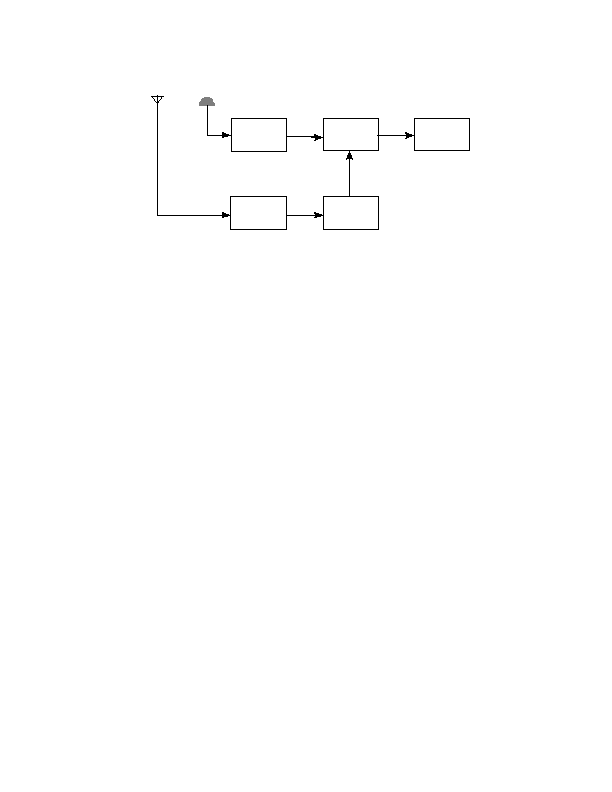
Figure 10 3. Typical UE Block Diagram
10.6 DGPS INTEGRITY
DGPS does more than increase positioning accuracy, it also enhances GPS
integrity by compensating for anomalies in the satellite ranging signals and
navigation data message. The range and range rate corrections provided in the
ranging code DGPS correction message can compensate for ramp and step type
anomalies in the individual satellite signals, until the corrections exceed the
maximum values or rates allowed in the correction format. If these limits are
exceeded, the user can be warned not to use a particular satellite by placing "do
not use" bit patterns in the corrections for that satellite (as defined in or RTCM SC
104 message formats) or by omitting the corrections for that satellite. Step
anomalies will normally cause carrier phase DGPS receivers to lose lock on the
carrier phase, causing the reference and user receivers to reinitialize. User
receiver noise, user processing anomalies, and multipath at the user GPS antenna
cannot be corrected by a DGPS system. These errors are normally small and
included in the overall DGPS error budget.
Errors in determining or transmitting the satellite corrections may be passed on to
the differential user if integrity checks are not provided within the reference station.
These errors can include inaccuracies in the reference station antenna location(s)
that bias the corrections, systematic multipath due to poor antenna sighting (usually
in low elevation angle satellites), algorithmic errors, receiver interchannel bias
errors, receiver clock errors, and communication errors. For these reasons, DGPS
reference station designs typically include integrity checking provisions to
guarantee the validity of the corrections before and after broadcast.
In a local area DGPS system that provides integrity checks on the corrections at the
reference station, Receiver Autonomous Integrity Monitoring (RAIM) may not be
10 10
<< < GO > >>