CHAPTER 10: DIFFERENTIAL GPS
10.1 INTRODUCTION
Differential GPS (DGPS) was developed to meet the needs of positioning and
distance measuring applications that required higher accuracies than stand alone
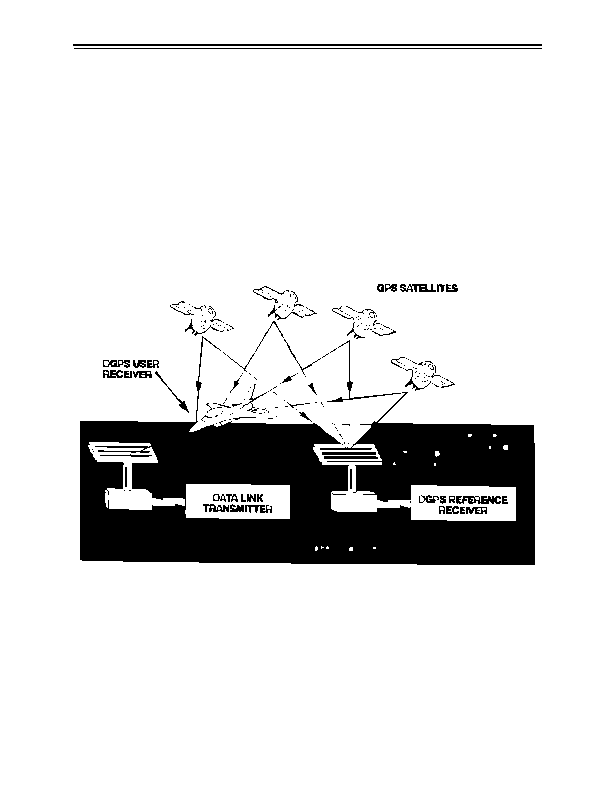
GPS could deliver. A typical differential GPS architecture (see Figure 10 1)
consists of a reference receiver located at a surveyed, known location, and one or
more DGPS user receivers. The user receivers are often called "mobile" receivers
because they are not confined to a fixed location like the reference receiver. The
Reference Receiver antenna, differential correction processing system, and data
link equipment (if used) are collectively called the Reference Station. Both sets of
receivers either collect and store the necessary data for later processing, or send
them to the desired location in real time via the data link.
Figure 10 1. Typical Differential System Architecture
This overview outlines some of the fundamental issues of DGPS. These issues should
be considered by any user considering the need for a positioning system that can give
accuracies better than the absolute PPS or SPS performance.
10 1
<< < GO > >>