2.7 ANALOG/DIGITAL RECEIVERS
The majority of early GPS receiver designs made extensive use of analog signal
processing techniques, however, most modern receivers incorporate digital signal
processing to replace analog receiver functions wherever possible. The following
examples are provided to give a description of the differences between these two
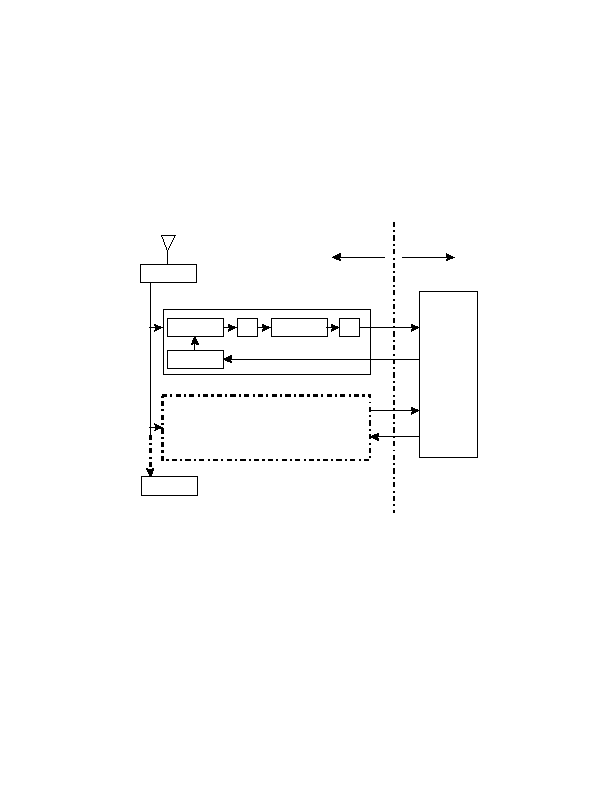
design techniques. Figure 2 1 shows a multi channel GPS receiver in which code
correlation is performed using analog mixing techniques at the intermediate
frequency (IF). Each satellite signal to be tracked requires a separate hardware
processing channel which consists of an analog correlator, code translator, IF
stage, and base band converter. The bandwidth of the IF stage is designed to
accommodate the GPS data rate and maximum carrier doppler shifted frequency.
ANALOG
DIGITAL
PRESELECTOR
GAIN
FINAL
DOWN
CORRELATOR
A/D
IF
CONVERSION
CHANNEL 1
TRANSLATOR
SIGNAL
AND
DATA
PROCESSING
CHANNEL 2
OTHER CHANNELS
Figure 2 1. Analog GPS Receiver Architecture
Figure 2 2 illustrates a GPS receiver using a largely digital architecture. Analog
signal processing is limited to preselection and gain applied to the GPS signals
during down conversion with fixed translation frequencies. The down converted
signals are digitized through sampling and are then ready for further digital
processing. The digital signal processor (DSP) functions shown in Figure 2 2
include correlation, code and carrier acquisition, and data recovery.
2 7
<< < GO > >>