The delay in the receiver s code is a measure of the transit time of the signals between the satellite
and the receiver s antenna and hence, the range between the satellite position and receiver
position. This measurement is called a pseudorange measurement, rather than a range
measurement, because the receiver s clock bias has not been removed.
Receivers typically use phase locked loop techniques to synchronize the receiver s internally
generated code and carrier with the received satellite signal. A code tracking loop is used to track
the C/A and P code signals while a carrier tracking loop is used to track the carrier frequency.
The two tracking loops work together in an interactive process, aiding each other, in order to
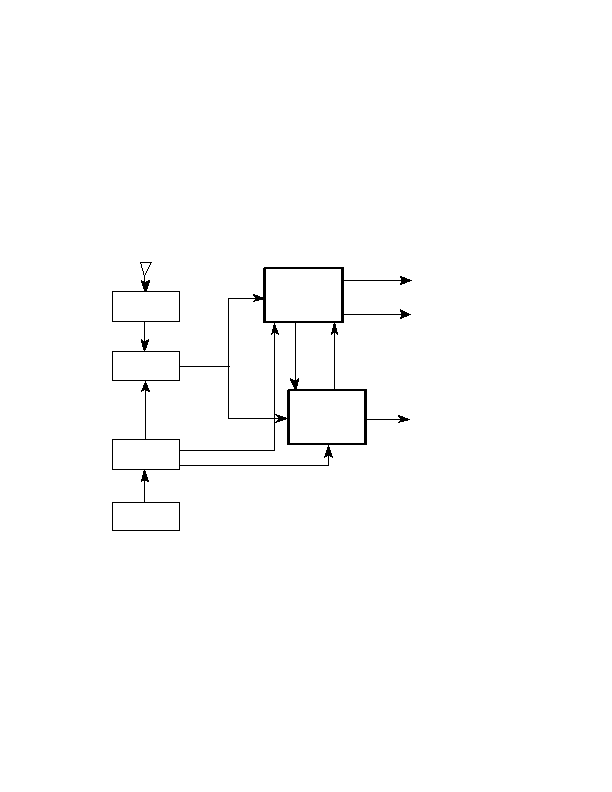
acquire and track the satellite signals. A generic GPS receiver tracking system is illustrated in
Figure 1 9.
ANTENNA
PSEUDO
DELTA RANGE
CARRIER
MEASUREMENT
TRACKING
CHANNEL
PREAMPLIFIER
50 Hz
NAVIGATION
DATA
DOPPLER
EST.
IF SIGNAL
ON TIME
RF CONVERTER
EST.
CODE
TRACKING
PSEUDO RANGE
CHANNEL
MEASUREMENTS
LO IF
FREQUENCY
SYNTHESIZER
REFERENCE
OSCILLATOR
Figure 1 9. Generic GPS Receiver Tracking System
1.4.2.3 Down Conversion
The received RF signal is converted, usually through two intermediate frequencies (IF), down to a
frequency near the code baseband, that can be sampled by an analogue to digital (A/D) converter.
Inphase and quadrature digital samples are taken to preserve the phase information in the
received signal. The samples are usually two bits to reduce conversion losses. The sampling rate
must be higher than the code chipping rate for a non return to zero code, that is, greater than
10.23 MHz for the P(Y) code. To ensure the phase of the received signal is maintained, all local
oscillators are derived from, and phased locked through, a series of synthesizers derived from the
receiver s master oscillator. Following the A/D conversion there
1 12
<< < GO > >>